Beyond formal schooling – defining the blurry space that is Nonformal Education (NFE)
NFE is an essential learning space, often overlooked in resources, research, attention, and perceptions of education.

Human learning has evolved and shifted over time, with countless learning forms that have existed around the world. Though current understandings of education often emphasis formal school systems practices, forms of learning are vastly varied and offer different benefits for supporting lifelong learning around the world. Across these learning formats, a common framing is to consider learning in three overarching buckets across a continuum: formal education, nonformal education, and informal education.
The Educational Continuum
Formal Education
“The highly institutionalized chronologically graded and hierarchically structured education system spanning pre-school and lower primary school to the upper reaches of university.”
Nonformal Education
“Any organized, systemic, educational activity carried on outside the framework of the formal system [of education] to provide selected types of learning to particular subgroups in the population, adults as well as children.”
Nonformal Education
“The lifelong process by which every person acquires knowledge, skills, attitudes and insights from daily experiences and exposure to the environment at home, at work and at play. Generally informal education is not organized or systematic, yet it accounts for the great bulk of any person’s total lifetime learning.”
Coombs & Ahmed (1974) Attacking Rural Poverty: How Nonformal Education Can Help (p. 8)
Building Beyond the Continuum
There are other ways of looking at the wealth of learning forms around the world and terms people have used to differentiate types (e.g., popular education, community education, and more). Here, we follow this idea of a fluid educational continuum as one resource for us to explore learning beyond traditional formal education practices. Within this continuum, many prioritize formal schooling; yet al three forms of education are essential, with each providing important modes of learning.
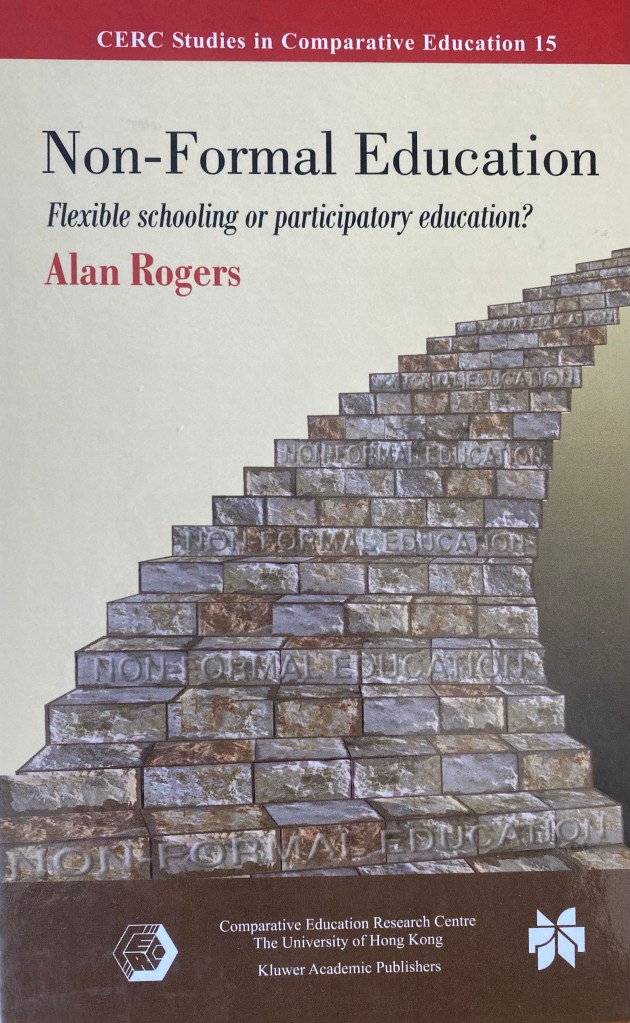
NFE in particular offers benefits through its ability to embrace prescribed learning structure that can be contextually adapted that can encourage participatory, experiential learning forms beyond the bounds of formal education. Alan Rogers wrote one of the seminal works on NFE, offering historical framings and definitions of NFE reflective of the shifting nature of education that has evolved. He instead suggest that the contextually adaptable nature of NFE and informal education should be included across these definitions.
The Educational Continuum – Contextualized
Formal Education
“That education which is highly decontextualised, not adapted to the individual student participants”
Nonformal Education
“That education which is partially de-contextualised and partially contextualised (flexible schooling)”
Informal Education
“That education which is highly contextualised, individualised and small-scale (participatory education)”
Rogers (2005) Non-Formal Education: Flexible schooling or participatory education? (p. 261)
As our world becomes increasingly connected and lines between these forms of education become blurred. Yet the need for the flexible, contextually adaptable, and engaging NFE practices remains an essential piece of education in lifelong learning.
“Characterised by a high degree of flexibility and openness to change and innovation in its organisation, pedagogy and delivery modes, nonformal education caters to diverse and context-specific learning needs of children, young people and adults worldwide”
UNESCO (2014) Non-formal Education as a Means to Meet Leaning Needs of Out-of-School Children and Adolescents. (p. 4)

 NFE Network